In recognition of World Humanitarian Day, this blog explores what humanitarian work looks like beyond the immediate emergency. Through the perspectives of two of VWB's local partners in Ukraine—Charity Fund Agrarian Development and Happy Paw Charity Foundation—it examines how restoring livelihoods, preserving compassion, and strengthening community resilience are all essential to long-term recovery.
Where Recovery Takes Root
When disaster strikes, humanitarian work is often understood through moments of urgency. Images of emergency food distributions, medical teams responding to crisis, and families fleeing conflict with only what they can carry shape our understanding of what humanitarian response looks like. These moments deserve our attention. They save lives, provide comfort in the midst of chaos, and meet the immediate needs of people facing unimaginable circumstances.
Yet recovery rarely happens in the same dramatic way.
Long after the cameras have moved on, another kind of humanitarian work begins. It unfolds gradually, often far from international headlines, as communities begin the difficult task of rebuilding what conflict or disaster has disrupted. It is measured not only by whether people survive today, but by whether they can once again earn a living, care for those who depend on them, and imagine a future beyond crisis.
In Ukraine, where communities continue to live with the realities of war, this quieter work is taking place every day. Sometimes that work begins by helping a family rebuild a poultry flock. Sometimes it begins by rescuing a cat from the rubble of a missile strike. Either way, it begins by helping communities take their first steps toward recovery.
To mark World Humanitarian Day, we spoke with two people from VWB's local partner organizations in Ukraine whose work looks very different on the surface but is united by a common purpose: helping communities rebuild with dignity.
For Oleksandr Khodakivskyi, President and Head of the Charity Fund Agrarian Development, recovery begins by helping families regain the ability to provide for themselves. For Nina Lozinska, Fundraiser with the Happy Paw Charity Foundation, it begins by recognizing that caring for animals is also a way of caring for people. Together, their stories offer a broader picture of humanitarian work—one that extends beyond emergency relief and into the long process of recovery.
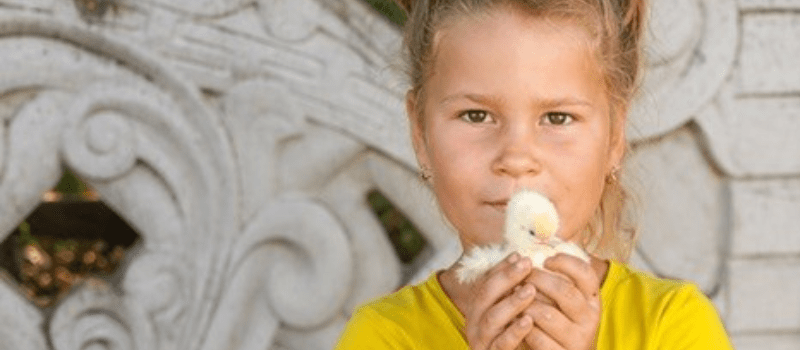
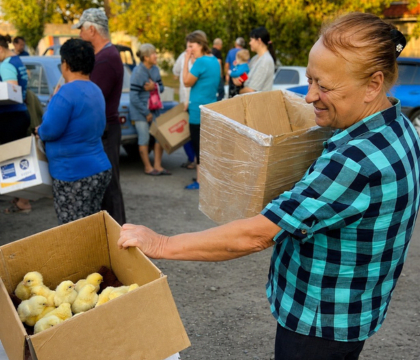 PHOTO: VWB supported chick distribution in Kharkiv.
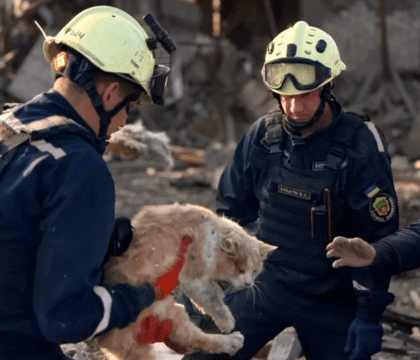 PHOTO: Lelik the cat rescued from the rubble.
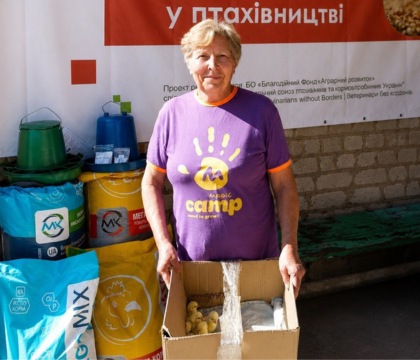 PHOTO: Poultry farmer, Olena Didyk, receiving chicks.
Recovery Begins with the Ability to Provide
War destroys more than buildings. It interrupts routines, erodes livelihoods, separates families from the lives they once knew, and leaves people wondering not only how they will survive today, but how they will support themselves tomorrow. That is where Oleksandr Khodakivskyi's work begins.
Through the Poultry Farming and Veterinary Education (PAVE) project, his team supports rural households in rebuilding small-scale poultry production. Families receive practical training, mentoring, and technical support that helps them transform a one-time investment into an ongoing source of food and income. Rather than simply distributing resources, the project equips participants with the knowledge and confidence to continue long after the initial assistance has ended.
 "We do not simply provide a resource," Oleksandr explains. "We help families turn that resource into knowledge, production, and independence."
Throughout our conversation, he returns to a simple but profound idea: humanitarian assistance should not end with distribution. Its greatest success lies in helping people regain the ability to make decisions for themselves—to produce, to plan, to adapt, and eventually to support others.
When people move from recipients of assistance to active participants in their own recovery, humanitarian aid becomes something more enduring than emergency relief. It becomes an investment in resilience.
One Person Can Change a Community
A small poultry flock may not seem transformative from the outside. Yet for a household that has lost income, livestock, or access to reliable food, it can restore several things at once: nutritious meals, modest income, practical skills, and perhaps most importantly, a renewed sense of agency. Families begin planning for the next production cycle, building on what they have learned, and looking beyond immediate survival toward long-term stability.
That shift becomes especially meaningful in the story of Olena Didyk, a woman from the Mykolaiv region who remained in her community throughout the occupation. Even while shelling continued, she risked her own safety each day to feed dogs and cats abandoned when families fled.
After liberation, she and her husband began rebuilding their household and joined the PAVE project to expand into poultry production. Already trained as a veterinary feldsher, Olena strengthened her expertise through the project's mentoring before eventually becoming a veterinary consultant herself, helping other households navigate the same challenges she had faced.
For Oleksandr, her journey captures the true purpose of humanitarian work. "An investment in one person can become practical support for an entire community."
Her story is a reminder that recovery is rarely something delivered from the outside. More often, it grows from within communities themselves, as knowledge is shared, confidence spreads, and people who once received support become a source of strength for others.
Preserving Compassion in Times of Crisis
At first glance, rebuilding a poultry flock and supporting companion animals appear to belong to entirely different worlds. One focuses on livelihoods and food security. The other centres on animal welfare. Yet both reflect the same understanding of humanitarian recovery: people cannot fully rebuild their lives if the relationships, routines, and sources of stability that sustain them are overlooked.
 For Nina Lozinska, those relationships often begin with the animals people refuse to leave behind.
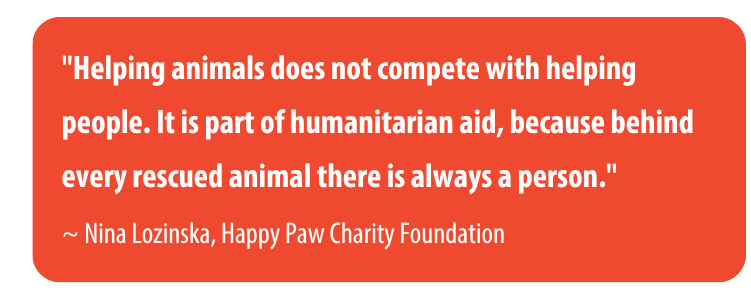
She has heard the criticism before: "During a war, we need to save people, not animals." To Nina, however, the statement presents a false choice. "Helping animals does not compete with helping people," she says. "It is part of humanitarian aid, because behind every rescued animal there is always a person."
It is a perspective shaped by years of witnessing the ways people cling to the animals they love, even amid extraordinary hardship. Across Ukraine, shelters have become temporary homes for animals evacuated from combat zones, while veterinary missions continue reaching communities affected by the war. Spay and neuter programs, emergency veterinary care, and support for local shelters all contribute to something larger than animal welfare alone. They help preserve the bonds that offer families comfort, stability, and a sense of normalcy when so much else has been lost.
The stories Nina shares are, on the surface, stories about rescued animals. There is Lelik, the cat pulled from the rubble after an airstrike in Zaporizhzhia and eventually reunited with his owner. There is Elvis, a young dog abandoned near a highway who found safety and a new family after a veterinary mission. And there is Mus, a tiny kitten rescued beside the wreckage of a rocket strike, who lost a leg but not the chance for a new life.
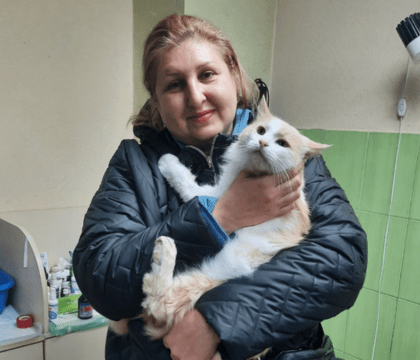 PHOTO: Lelik the cat reunited with his owner.
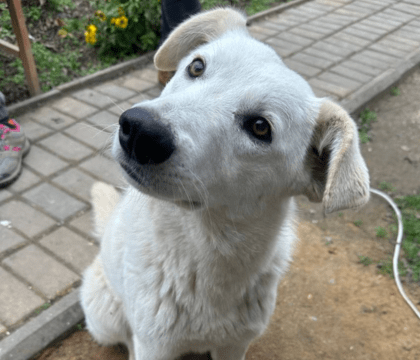 PHOTO: Elvis, a rescued dog, enjoying his new family life.
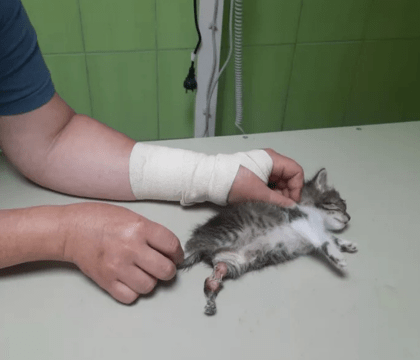 PHOTO: Mus the kitten receiving emergency care.
Yet none of these stories are really about animals alone. "They remind us," Nina reflects, "that humanitarian aid isn't just about survival. It's about giving people and animals a chance to regain a sense of safety, home, and a future."
Throughout the war, she has watched people carry cats through evacuation routes, search bomb sites for missing dogs, and bring animals to veterinary missions by bicycle, wheelbarrow, and even baby stroller despite the constant threat of shelling. These acts may appear small in comparison with the scale of the conflict, but together they speak to something profoundly human. Caring for animals is not separate from caring for communities. It is one of the ways communities continue caring for one another.
The Quiet Work of Recovery
Although Oleksandr and Nina approach humanitarian work from very different perspectives, their conversations repeatedly arrive at the same place.
Neither begins by talking about aid. Instead, both begin by talking about people. People who want to work again. People who continue caring for neighbours despite years of uncertainty. People who refuse to abandon the animals that have shared their homes and lives. People who choose compassion, even when surrounded by destruction.
Both also describe hope not as optimism, but as something built through everyday action. Oleksandr sees it in rural communities that continue repairing farms, sharing knowledge, and rebuilding local leadership despite years of disruption. Nina finds it in volunteers, shelter staff, donors, teachers, veterinarians, and ordinary Ukrainians who continue opening their homes, supporting one another, and teaching children empathy and responsible animal care.
 Neither imagines recovery arriving all at once. Instead, they describe it as something built piece by piece, relationship by relationship, community by community.
Perhaps that is the part of humanitarian work the world sees least. Not the emergency itself, but everything that follows. The patient work of restoring confidence. The quiet work of rebuilding livelihoods. The daily decision to keep caring—for neighbours, for communities, and for the animals that depend on them.
World Humanitarian Day reminds us to recognize those who dedicate themselves to helping others during times of crisis. Some respond in the immediate aftermath of disaster. Others remain long after the emergency has faded from international attention, helping communities rebuild livelihoods, restore confidence, strengthen local capacity, care for animals, and preserve the relationships that make recovery possible.
In Ukraine, that work continues every day. It happens in villages rebuilding small farms, in veterinary missions reaching isolated communities, in shelters caring for displaced animals, and in countless acts of generosity that rarely make the headlines.
These stories show that humanitarian work is not defined only by the crises it responds to, but by the future it helps create. Recovery is about more than surviving conflict. It is about ensuring that people have the opportunity, the knowledge, and the support to rebuild their lives with dignity—and that no one, whether person or animal, is left behind.
 Veterinary care is more than an animal health service—it is a foundation for food security, public health, and community resilience. Join VWB in supporting locally led solutions that help people, animals, and communities recover and thrive. Donate, volunteer, or subscribe to stay connected to VWB's work in Ukraine and around the world.