In this edition of #VETSVolunteerVoices, we shift perspective — from volunteer reflections to the voice of a local leader shaping change on the ground. Dr. Victoria Norgbey has dedicated over four decades to strengthening Ghana’s poultry sector and empowering women through WIPVaC-Apex Ghana, a key VETS program partner working across all 16 regions of the country.
From Teacher to Poultry Leader
For over 40 years, I have worked in Ghana’s poultry sector — first as an Agricultural Science teacher, and later as a farmer, mentor, and advocate.
I began my journey teaching Agricultural Science at Achimota School in Accra, where I served for 15 years. While teaching, I started a small backyard poultry farm. What began modestly has grown over time into a private farm with a capacity of 5,000 birds. Along the way, I have served as a trainer, mentor, and coach, committed to building a sustainable poultry industry in Ghana.
My passion for women’s empowerment led me to take on the leadership of WIPVaC-Apex Ghana in 2017 — I had the privilege of serving as President until 2026. During that time, I saw firsthand that many women in the poultry value chain had strong determination but limited access to technical knowledge, financial literacy, and leadership opportunities. Many groups were fragmented, operating in isolation without unified representation.
We needed to come together. WIPVaC-Apex Ghana was created as an umbrella body to bring together women across the entire poultry value chain — from hatcheries and day-old chick suppliers to processors and consumers. Advocacy is all about numbers, and when women stand together, our voices become stronger.
 PHOTO: Dr. Norgbey interviewed by local Accra media during her term as President, WIPVaC-Apex Ghana.
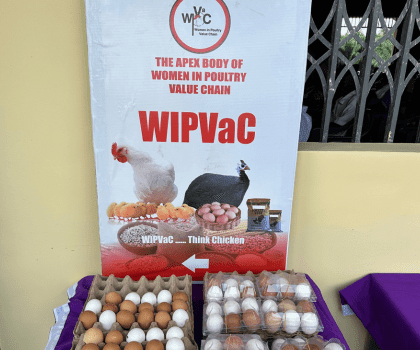 PHOTO: PHOTO: WIPVaC-Apex eggs for sale at a Women's Day event during the 2024 Hogbetsotso Festival in Adidome.
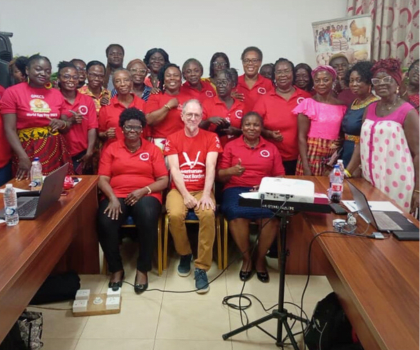 PHOTO: Dr. Norgbey (front row, left) and VETS volunteer Guy Audet (front row, center) at a WIPVaC-Apex training in Accra.
Uniting Women Across Ghana’s Poultry Value Chain
Before partnering with Veterinarians Without Borders through the VETS program, many women faced challenges in poultry production, record keeping, accessing start-up capital, and marketing their products. Leadership structures were weak in some regions, and opportunities for visibility were limited.
Our partnership began after we met the VETS team through the Ghana Poultry Network. Following a due diligence process, we were recognized as a credible women-led organization with the capacity to reach farmers across all 16 regions of Ghana.
What has changed since then is significant.
The VETS trainings have strengthened our technical capacity in areas such as biosecurity, One Health, gender inclusion, and business planning. They have also allowed us to reach communities in the far hinterland — areas that were previously difficult to access. The volunteers were always willing to travel long distances to train our members. That resilience made an impression on us.
Inclusivity has become a defining feature of our work. People with disabilities have benefited from the trainings. Municipal and District Directors of Agriculture and Veterinary Officers now participate in our sessions. Regional leaders from WIPVaC-Apex have been invited to sit on district committees, contributing to decision-making processes that shape agricultural development.
Visibility has grown. Several members have won National Farmers Day awards — and I myself now serve on the Veterinary Council of Ghana, where national animal health policies are discussed.
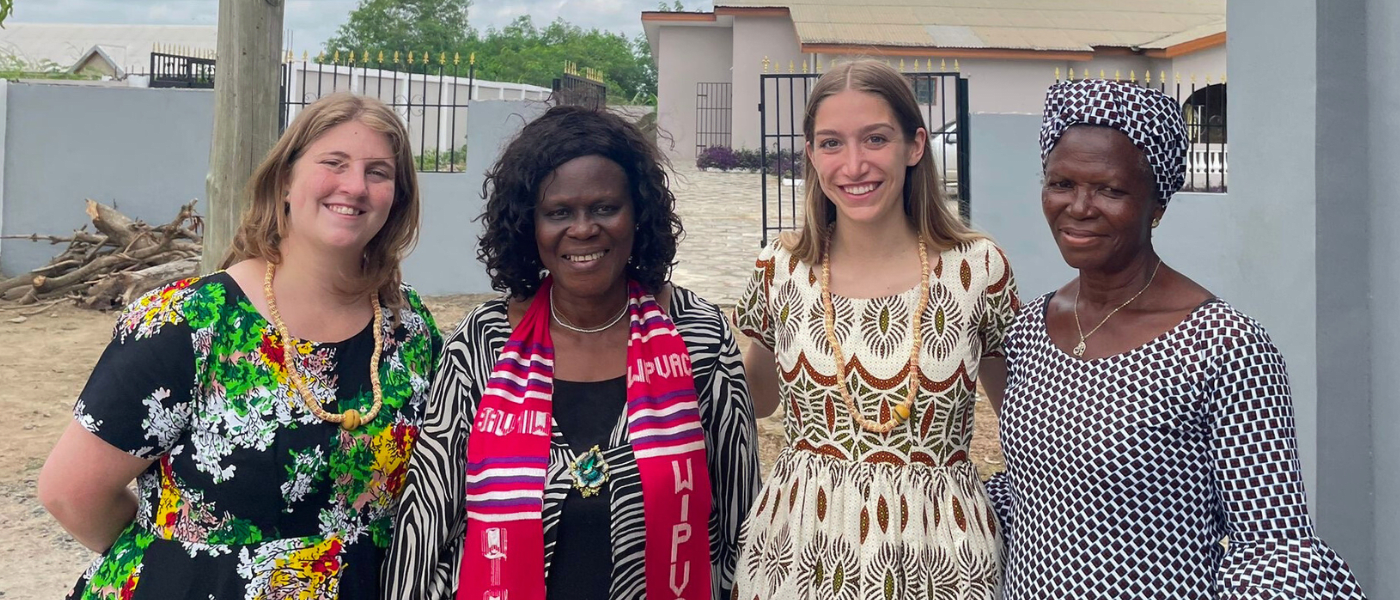 PHOTO: VETS volunteers Kayla Williams and Hannah Riegger with Dr. Victoria Norgbey (President, WIPVaC-Apex; 2nd from left) and Mary Amaglo (Regional Coordinator; far right).
A Game Changer for Women Farmers
One story that captures this transformation is that of Yaa Aduba Asare, a member of our Central Regional Chapter in Cape Coast. Yaa once struggled with farm management and technical challenges. There were times she felt overwhelmed and discouraged. The training provided by VETS volunteers became a “game changer” for her. She strengthened her management skills and improved her technical practices. Today, she confidently manages 5,000 birds.
Yaa has grown from a beginner who once cried during difficult times into a confident leader and award-winning Best Female Farmer in the Adentan Municipality. She credits this transformation to the constant support and capacity building provided through the partnership between WIPVaC-Apex Ghana and the VETS program.
Her story is not unique. Across the country, women are lowering mortality rates, improving production processes, and increasing income for their families.
More Than Training: Human Connection
Beyond technical knowledge, the partnership has also created meaningful human connections. I remember one moment with Business Plan Development Advisor, Guy Audet. He shared that his mother was a farmer and that he grew up seeing her care deeply for other women in her community. That experience shaped his own commitment to supporting women in agriculture. He later joined us in celebrating International Women’s Day, encouraging our members to continue striving and impacting lives.
Moments like these remind us that partnership is not only about skills — it is about shared purpose.
Inclusivity and Empowerment
If I had to describe the value of this partnership in two words, it would be inclusivity and empowerment. Through the VETS program, rural women who were previously marginalized have gained access to training, networks, and opportunities. Women are participating more confidently in decision-making processes. Regional chapters are operating independently with stronger leadership and financial systems.
The Entrepreneurship Savings and Loans Group (ESLG) scheme has allowed members to mobilize resources, build poultry structures, expand their flocks, and strengthen group cohesion. These are sustainable systems that will outlast any single project.
Looking Ahead
As I look to the future, I am hopeful. WIPVaC-Apex Ghana continues to grow stronger, and I remain deeply committed to supporting its growth and the women it represents. Regional chapters are building their own capacity while staying connected under a unified vision. Within the broader Ghanaian poultry sector, we aim to remain at the forefront of transformation — advocating for women, promoting good husbandry practices, and contributing to food security.
Sustaining partnerships like the one we share with the VETS program will be essential. Together, we are not only strengthening poultry production — we are building leadership, confidence, and opportunity for women across Ghana.
VETS is an 8-year initiative (2020-2028) to improve the economic and social well-being of marginalized people, particularly women and girls, in 6 countries across Africa and Asia. In collaboration with local partners, the program is implemented through 190 Canadian volunteers on international assignment and is generously funded by Global Affairs Canada. Learn more.