This blog was written by Tanja Kisslinger, Director of Communications at VWB, in reflection of a trip to Senegal in October 2025 to document our Community One Health Empowerment in Rwanda and Senegal (COHERS) program. Photos by Jess Holing for VWB.
Before the meeting officially begins, music drifts across the clearing from large speakers mounted on the back of a pickup truck. Slowly, community members — mostly women — arrive in small groups, greeting one another and settling into the plastic chairs arranged in a semi-circle beneath the shade of a massive mango tree. A microphone crackles, then steadies.
Before any health messages are shared, the village chief is handed the microphone to open the gathering. His presence matters — it signals respect, legitimacy, and shared responsibility. Only after his prayer does the session formally begin.
Notably, this is not an emergency meeting. There is no outbreak unfolding, no visible crisis to respond to. And yet the gathering is taken seriously — structured, well attended, and carefully facilitated by VWB’s local partner, Agronomes et Vétérinaires Sans Frontières Senegal (AVSF Senegal).
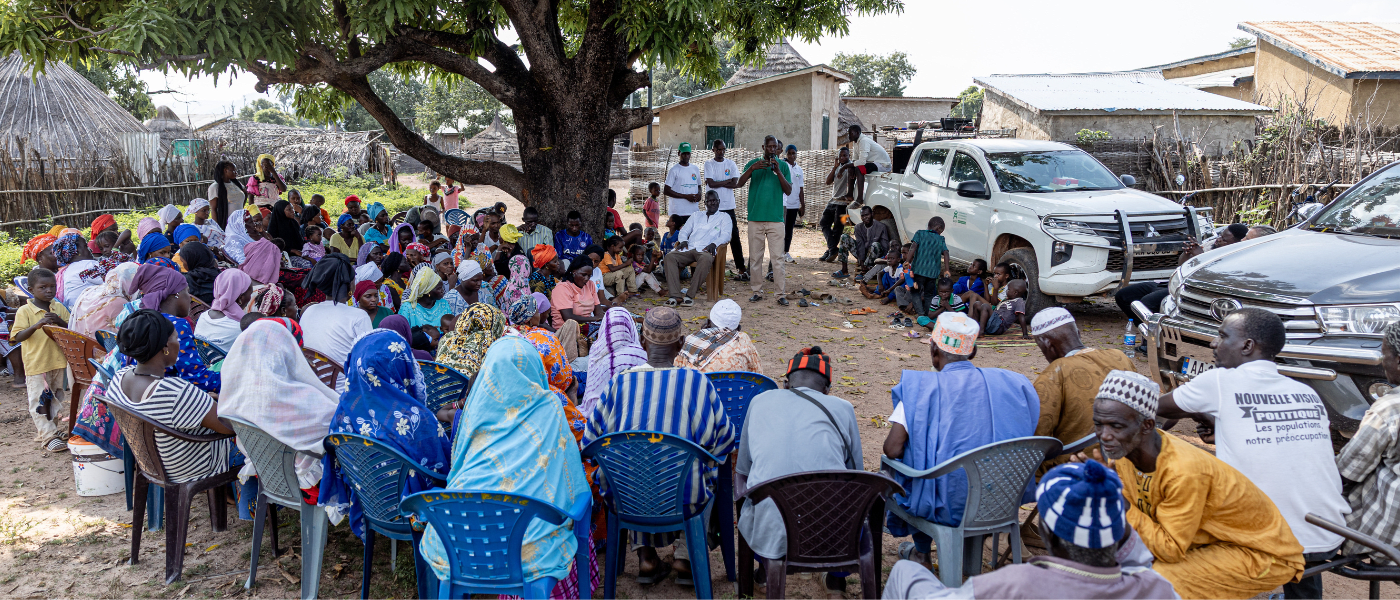 PHOTO: Community members gather in Thiangué village, Dindifello, for a COHERS-supported sensitization session led by local partners and Community Animal Health Workers.
This is what community sensitization looks like under the COHERS program in Senegal: formal but familiar, instructive yet accessible, and rooted in the belief that prevention must be built long before disease appears.
Prevention before crisis
In rural areas like Dindifello, livestock are central to daily life and livelihoods. Cattle, sheep, and goats are not only sources of food and income; they represent stability, savings, and security for families. When animals fall ill, the consequences ripple quickly through households and communities.
Anthrax is one of the zoonotic diseases COHERS is working to prevent in Senegal. While there is no current outbreak in this region, anthrax remains a persistent risk — a disease that can survive silently in the environment and re-emerge when conditions allow.
Here, prevention is not about reacting to crisis. It is about staying alert, informed, and connected — before anything goes wrong.
Who leads the conversation
The session is led by members of the local One Health Team, including Community Animal Health Workers (CAHWs) trained through COHERS. Among them is Khadia Diallo, one of only a handful of women CAHWs serving in this role within the commune.
Importantly, the CAHWs facilitating the discussion are herders themselves. They raise animals under the same conditions as their neighbours and face the same risks. Because of this shared experience, the conversation does not feel imposed or abstract. It feels grounded, familiar, and credible.
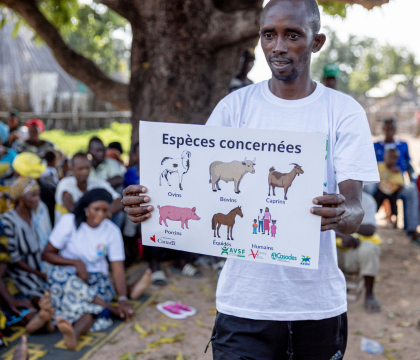 PHOTO: CAHW presenting information about anthrax.
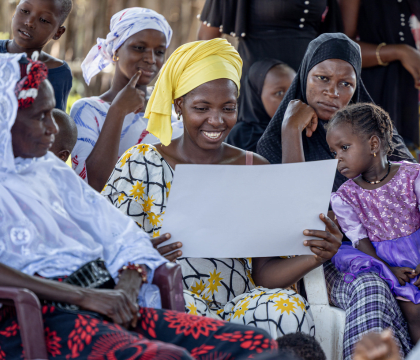 PHOTO: Participants engaging with visual tools.
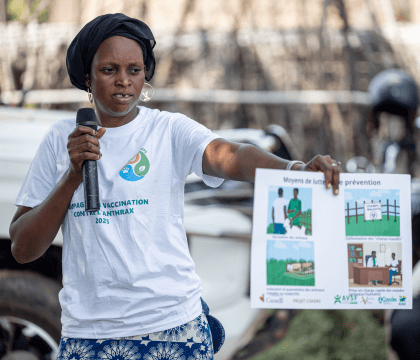 PHOTO: Khadia Diallo, CAHW, leading the discussion.
Using illustrated cards that are both presented to and distributed amongst the group, the facilitators invite participants to describe what they see and to think through scenarios. For example, one image shows a cow lying motionless on the ground, and another shows someone handling a carcass without protection. “What might be happening here?” a CAHW asks. “What would you do next?”
From these images, the discussion unfolds naturally. Participants talk through how disease can spread from animals to people, how soil and water can become contaminated, and why certain long-standing practices — however familiar — can be dangerous.
The messages are practical and direct. Do not touch dead animals. Do not open carcasses. Do not drag them across the ground. Report unusual illness or sudden livestock deaths early — to a CAHW, a veterinarian, or local authorities. There is no attempt to frighten people. The goal is not alarm but understanding — and shared responsibility.
Learning across sectors
Partway through the session, another speaker steps forward: a woman from a nearby health post. Her presence reinforces a central idea of One Health — that preventing zoonotic disease requires coordination across human and animal health systems.
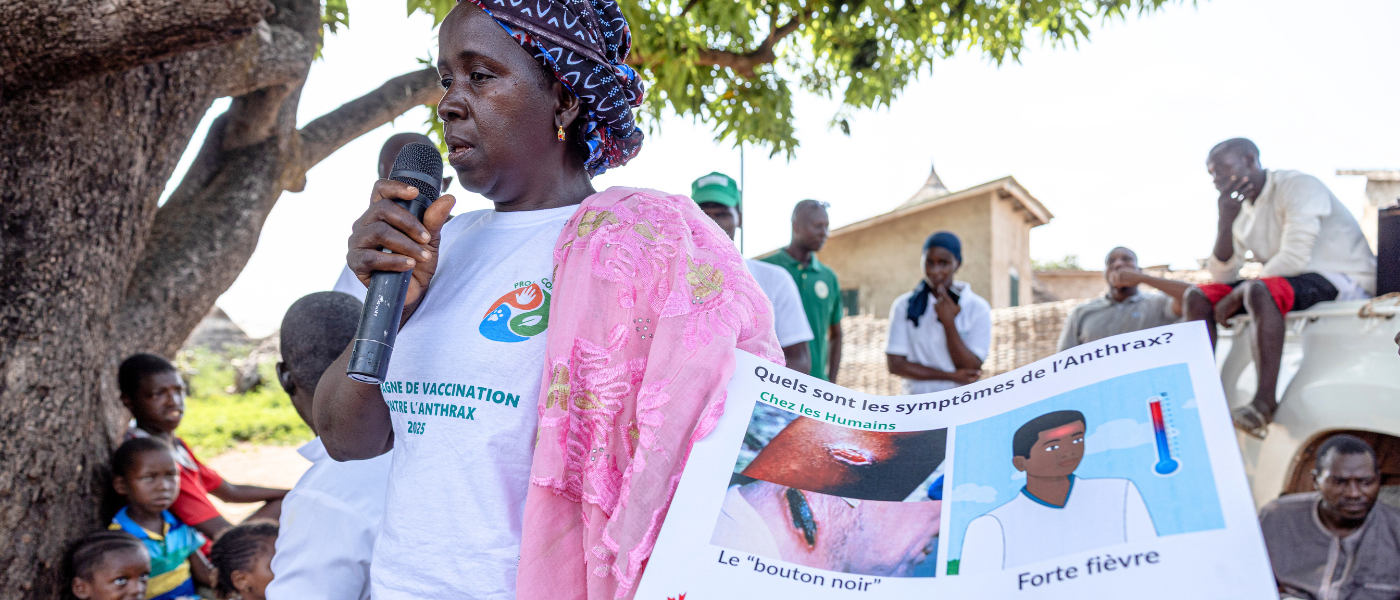 PHOTO: A health post worker joins the sensitization session, sharing human health perspectives alongside animal health messaging.
She speaks about cross-contamination in the home, emphasizing the importance of cooking food thoroughly and keeping sick animals away from household spaces. She explains that symptoms such as fever accompanied by small blisters on the skin can signal anthrax, and that any suspicion should prompt immediate action — calling a veterinarian or seeking care at the health post.
Her message complements those shared by the CAHWs, reinforcing the same principles from a different angle. Together, they underscore that early action, communication, and collaboration are essential to prevention.
Repetition as strategy
As the discussion continues, it becomes clear that many in the audience are already familiar with the messaging. People nod along, answer questions with confidence, and share examples from their own experience.
This familiarity is not accidental. Under COHERS, One Health Teams organize sensitization activities every month. While some take the form of larger community gatherings like this one, others are conducted door to door, with CAHWs visiting households in smaller groups to have more direct conversations.
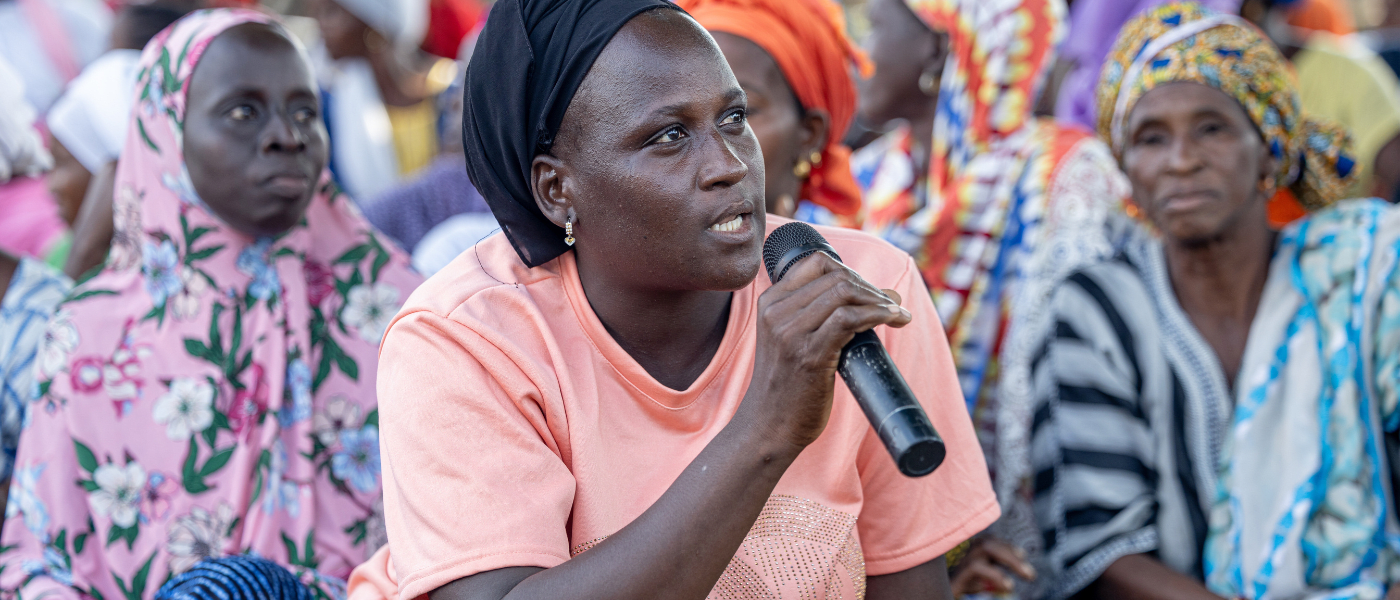 PHOTO: A community member recounts how she sought help from a CAHW after discovering a dead animal in her herd.
There are also evening “slide show nights,” when images are projected after dark to illustrate disease symptoms, transmission pathways, and prevention strategies — including hygiene practices and the use of basic protective equipment.
In places where veterinary services are limited and infrastructure gaps remain, trust is built through repetition. Through familiar faces, consistent messages, and a steady presence over time.
Participation and shared responsibility
As with many community health gatherings, most of the participants are women. This reflects daily realities: women are often responsible for caring for animals kept near the home, preparing food, managing hygiene, and responding first when something seems wrong.
Women CAHWs like Khadia play a particularly important role in these spaces. Their presence makes it easier for other women to ask questions, share concerns, and speak openly. At the same time, this dynamic highlights an ongoing challenge — prevention depends heavily on women’s engagement, even as the burden of implementing safe practices often falls disproportionately on them.
Community sensitization works best when it acknowledges this reality and encourages shared responsibility across households and communities.
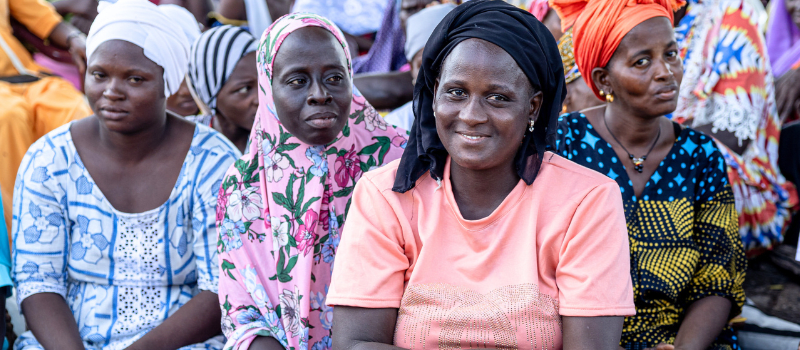
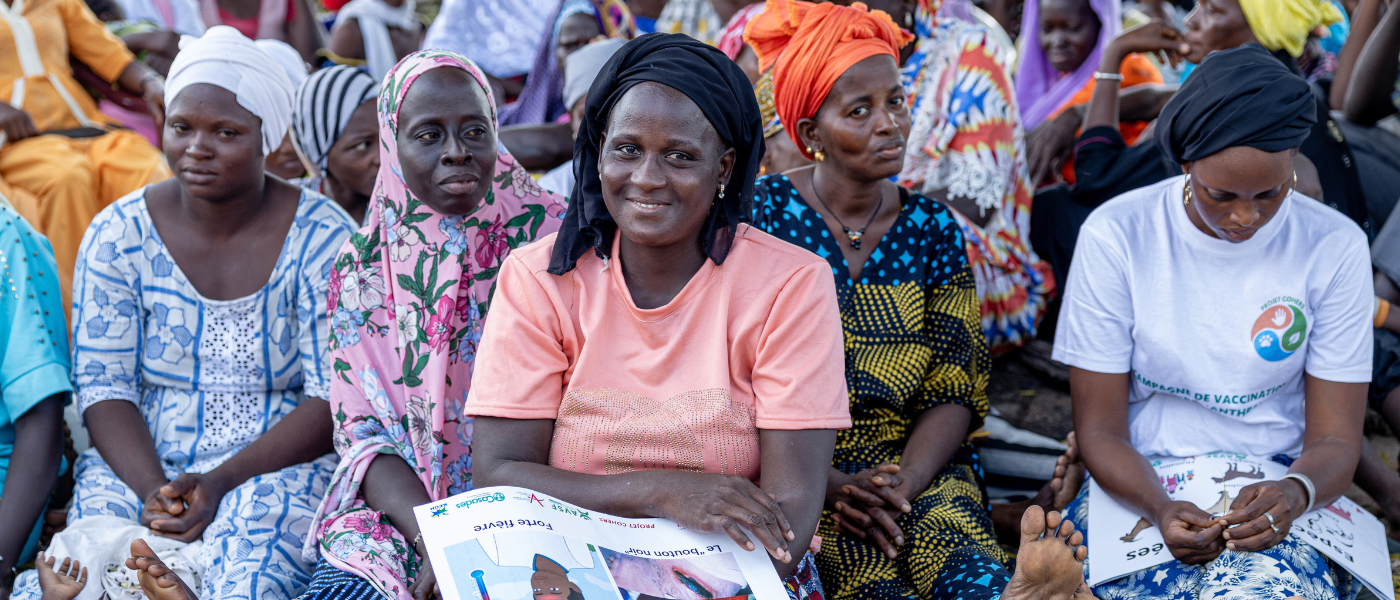 PHOTO: Khadia Diallo (far right) joins women from the community during the sensitization session — a familiar face among peers.
Closing the circle
As the session draws to a close, the tone lightens. Questions are posed to the group, and correct answers are rewarded with t-shirts, prompting laughter and good-natured competition. The activity may appear playful, but it serves an important purpose — reinforcing key messages while signaling appreciation for participation.
When the music resumes and chairs are stacked away, people disperse back to fields and homes. Nothing dramatic has occurred — and in many ways, that is the point.
Looking ahead
Prevention is rarely visible in the moment. Its impact is measured instead in outbreaks that never occur, animals that remain healthy, and livelihoods that stay intact. By investing in regular, community-led sensitization — led by trained CAHWs and supported by local health services — COHERS is helping to build that kind of quiet resilience in Senegal.
In places where disease can persist unseen for years, waiting for an outbreak is not a strategy. Building the capacity to talk openly, act early, and support one another is what makes prevention possible.
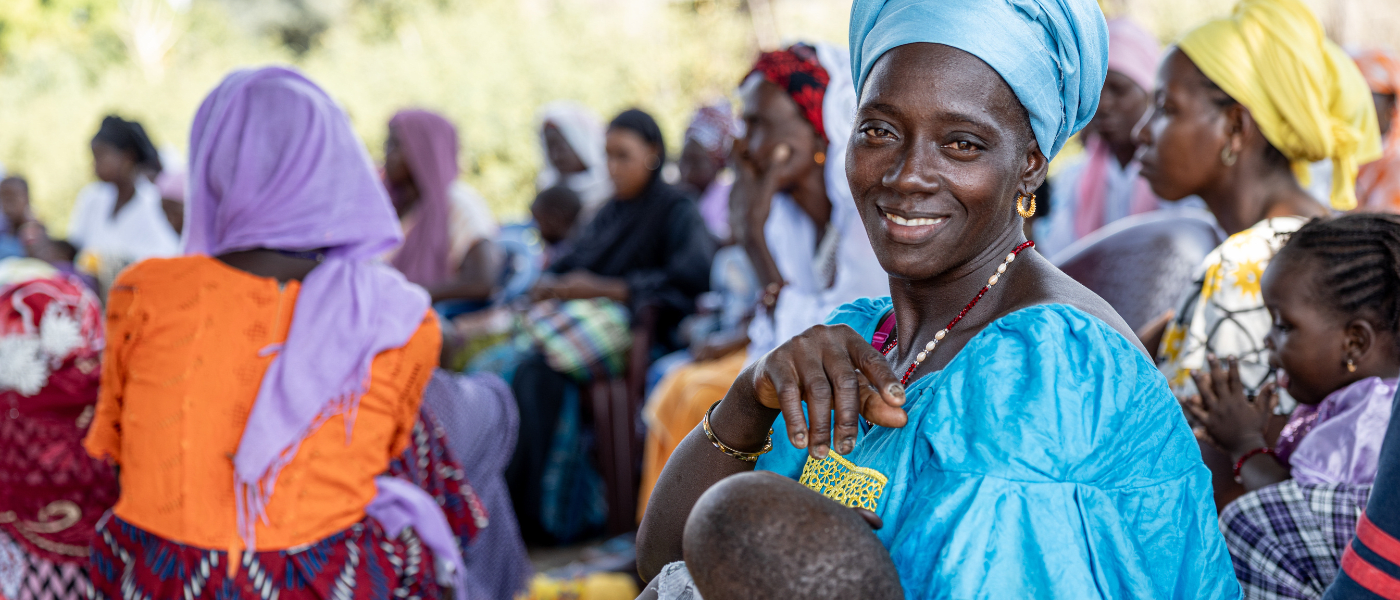 PHOTO: A participant smiles — grounded in the knowledge that over four years, COHERS will empower more than 127,000 people to protect their families through One Health practices.
COHERS is a four-year initiative (2023–2027) that strengthens community health systems to prevent zoonotic diseases in Rwanda and Senegal by uniting human, animal, and environmental health. Funded by Global Affairs Canada and led by VWB, COHERS is delivered with local and international partners including the University of Global Health Equity, WaterAid Rwanda, the University of Guelph, the Institute of Health Economics, and Agronomes et Vétérinaires Sans Frontières. Learn more.