Written by VWB Board Member Dr. Katinka de Balogh (DVM), former Senior Veterinary Public Health Officer at the Food and Agriculture Organization of the United Nations (FAO), and Tanja Kisslinger, Director of Communications at VWB. Published in recognition of World AMR Awareness Week 2026 (November 18–24).
Where do antimicrobials go next?
When we talk about antimicrobial resistance (AMR), much of the conversation centres on how antimicrobials are used: whether they are prescribed appropriately, administered correctly, or used unnecessarily. These are essential questions. Reducing the need for antimicrobial treatment, preventing infections, and ensuring responsible use remain fundamental to protecting the effectiveness of these medicines.
But another question deserves equal attention: What happens after an antimicrobial has been administered?
An antibiotic given to a patient or an animal does not necessarily disappear once treatment is complete. Depending on the drug and how it is administered, a proportion may leave the body through urine or faeces, sometimes retaining antimicrobial activity. Resistant microorganisms and the genes that enable resistance may also be shed into waste streams. Elsewhere, antibiotics can enter the environment through pharmaceutical manufacturing, agricultural applications, or the improper disposal of unused medicines [1, 2].
These pathways do not necessarily end at the same place. Some compounds bind to soil or sediment; others may move through wastewater, agricultural runoff, or interconnected water systems. Their behaviour depends on the substance, environmental conditions, and how waste is managed. This is where water becomes particularly important. Rivers, groundwater, wastewater systems, irrigation networks, and aquaculture environments connect activities that we typically manage separately. Human healthcare, livestock production, crop cultivation, pharmaceutical manufacturing, and environmental protection may operate under different institutions and regulations, yet their waste streams can converge.
Antimicrobial stewardship cannot end at the point of use. A One Health response must also consider what happens afterwards.
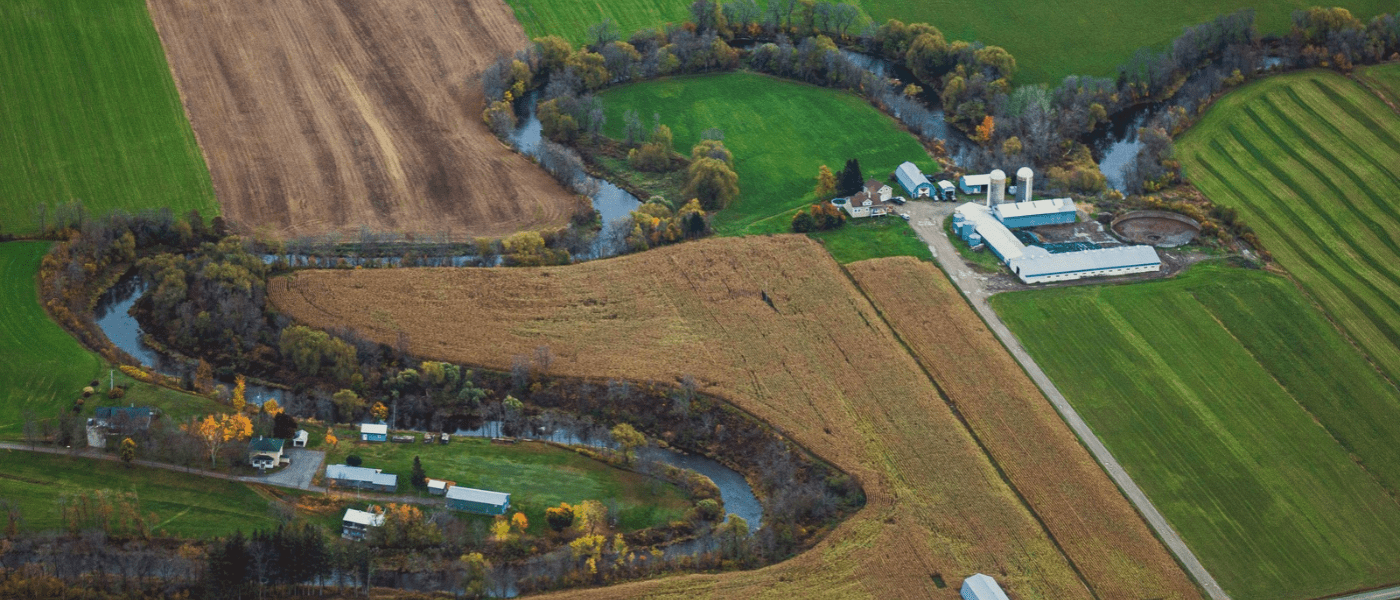 PHOTO: Agricultural land, livestock facilities and waterways are closely connected. These shared environments illustrate how substances from agricultural activities can move beyond their original point of use. (Location: Rivière-Ouelle, Quebec, Canada. Credit: Jonathan Richard/Unsplash)
1. Water as a One Health Connector
Water is more than a resource shared by people, animals, plants, and ecosystems. It is also a medium through which the consequences of antimicrobial use and waste management can move between them. The United Nations Environment Programme's 2023 report, Bracing for Superbugs, identified environmental pollution as an important dimension of AMR, highlighting contributions from healthcare, agriculture, pharmaceutical manufacturing, and inadequate sanitation and waste management [2].
Although AMR encompasses resistance in bacteria, fungi, viruses and parasites, the environmental pathways discussed here focus principally on antibiotics and bacterial resistance. Understanding these connections requires distinguishing three related, but different, phenomena:
- Antimicrobial residues are remnants of antimicrobial compounds that enter the environment through excretion, discharge, application, or disposal. Their persistence and biological activity vary considerably. Some degrade relatively quickly; others may remain in water, soil, or sediment under particular conditions.
- Antimicrobial-resistant microorganisms and resistance genes represent a different concern. Resistant bacteria may enter wastewater or agricultural waste through human and animal excretion, while antimicrobial resistance genes also occur naturally within wider environmental microbial communities. These genes can sometimes move between bacteria through processes known as horizontal gene transfer [2].
- Environmental selection for resistance is a third process. Under certain conditions, antibiotic residues may create selective pressure that favours resistant microorganisms over susceptible ones. Experimental research has demonstrated that this can occur even at concentrations below those needed to inhibit bacterial growth, although the conditions and concentrations at which selection occurs vary [3].
These distinctions matter. Finding antibiotic residues in a river does not automatically mean that resistant bacteria are developing there. Detecting resistance genes in wastewater does not, by itself, demonstrate that they will reach people or animals and cause infections. Nevertheless, the environmental pathways are sufficiently well established to warrant attention. Water can receive and transport residues, resistant organisms, and resistance genes, while some aquatic environments may also provide conditions that influence their persistence or selection. The challenge is to understand these processes without assuming that every detection represents the same level of risk.
2. Many Sources, Connected Systems
The environmental dimensions of AMR become clearer when we follow antimicrobial use beyond the settings in which it occurs.
Livestock Production and Manure Management
Livestock production provides one important example. Antibiotics administered to animals may be only partly absorbed or metabolized. Depending on the compound, species, and route of administration, a substantial proportion of a dose can be excreted through urine or faeces, either unchanged or as metabolites. Published reviews report considerable variation in excretion rates, reinforcing why no single percentage can adequately describe what happens across different treatments and production systems [1].
The route of administration also matters. Antibiotics may be administered orally, through feed or drinking water, or by injection. In poultry production, for example, medication delivered through drinking systems introduces practical considerations involving dosing, water consumption, and the management of any unused medicated water.
Manure may therefore contain antibiotic residues alongside resistant microorganisms and resistance genes. During storage, treatment, or application to agricultural land, these materials interact with soil microbial communities. Rainfall and runoff may subsequently carry some contaminants into nearby waterways, while other compounds remain bound to soil or sediment.
Waste-management practices can influence what happens next. Composting and anaerobic digestion, for example, can reduce concentrations of some antibiotic residues, although their effectiveness varies and the removal of resistance genes is less predictable [1, 4]. These processes should not be regarded as universally effective solutions, but they illustrate why manure management belongs within discussions of antimicrobial stewardship.
Healthcare and Wastewater
Human healthcare creates another set of pathways. Antibiotics administered in hospitals and communities can enter wastewater through excretion. Hospitals may also discharge wastewater containing resistant organisms and resistance genes associated with patient care. Where sanitation infrastructure or wastewater treatment is inadequate, these materials can reach receiving waters with limited treatment [2]. The distinction between sources is important. Hospital wastewater may contain concentrated mixtures of pharmaceuticals and microorganisms associated with healthcare settings, while municipal wastewater receives contributions from much larger populations. Their composition, treatment requirements, and potential environmental implications are not necessarily the same.
Aquaculture and Shared Water Systems
Aquaculture makes the connection especially visible. Fish and other aquatic animals live directly within the water systems that may receive antibiotic residues and resistant microorganisms. Antibiotics used in aquaculture can enter surrounding waters and sediments through excretion or uneaten medicated feed. The extent of exposure and environmental persistence varies with production practices, drug characteristics, and local conditions [5]. In some aquaculture systems, water is simultaneously the production environment, a potential route of antimicrobial exposure, and a pathway through which residues or resistant organisms may move beyond the farm. This makes aquaculture a particularly useful illustration of why antimicrobial use and environmental management cannot always be considered separately.
Pharmaceutical Manufacturing
Pharmaceutical manufacturing introduces a different concern. Unlike residues remaining after treatment, manufacturing effluent can contain antibiotic compounds released during production. High concentrations have been documented downstream of some facilities.
In 2024, the World Health Organization issued its first dedicated guidance on wastewater and solid-waste management for antibiotic manufacturing. The guidance provides a scientific basis for pollution-control targets intended to reduce risks associated with the emergence and spread of resistance, while recognizing the need to maintain equitable access to essential antibiotics [6].
This represents an important development: environmental AMR is increasingly being addressed not only through research and awareness, but also through standards that can inform regulation, procurement, and industrial practice.
Plant Production and Pharmaceutical Disposal
Plant production is another, less widely recognized pathway. Antibiotics such as streptomycin and oxytetracycline have been used to manage certain bacterial crop diseases, including diseases affecting fruit trees. Their application can introduce antibiotic compounds into soil and potentially surrounding water systems, raising questions about effects on environmental microbial communities [7]. Antibiotic use in plant agriculture is generally much smaller in scale than use in human or animal health in settings where comparative data are available. Nevertheless, its environmental implications deserve attention. One Health does not require every sector to contribute equally to a problem; it requires that relevant pathways are not overlooked simply because they fall outside traditional disciplinary boundaries.
Finally, antibiotics can enter waste systems without ever being administered. Unused or expired medicines may be flushed into drains, discarded with household waste, or improperly handled by healthcare and veterinary facilities. These disposal routes have different environmental consequences, depending on waste collection, treatment, and disposal infrastructure. UNEP's 2026 guidance on the safe disposal of unused medicines emphasizes waste prevention, take-back systems, appropriate legal frameworks, and public awareness as elements of a coordinated One Health response [8].
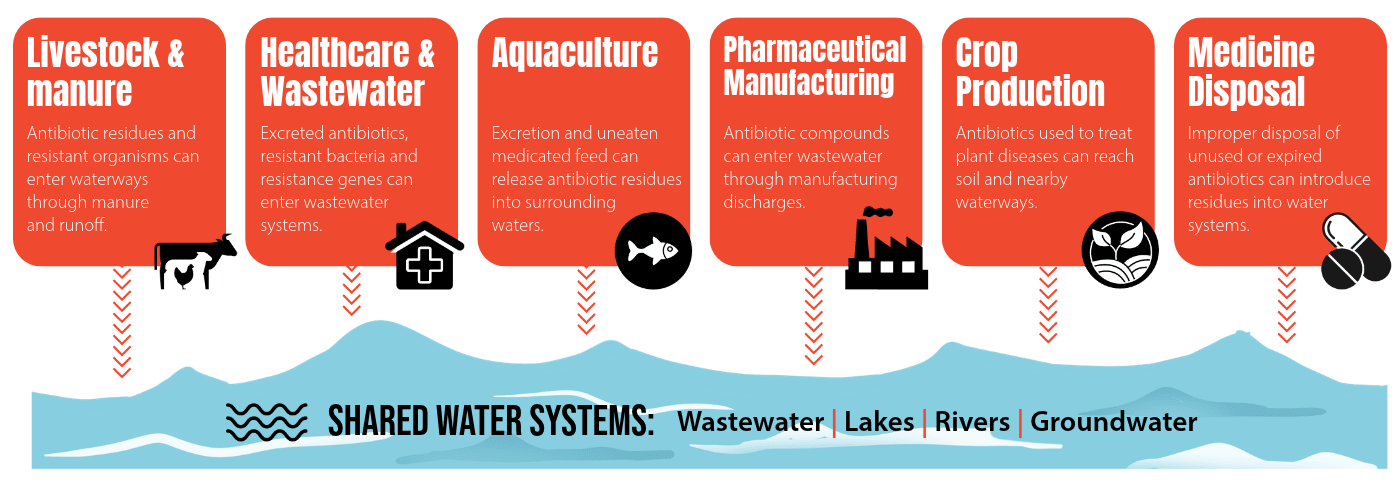
From livestock production and healthcare to aquaculture, pharmaceutical manufacturing, crop cultivation and medicine disposal, these sources should not be treated as equivalent in scale, composition, or risk. Nor do they contribute uniformly across regions or production systems. What connects them is a shared question: Once antibiotics, resistant organisms, or resistance genes leave their original point of use, what systems determine where they go—and what happens next?
Figure: How antibiotics and resistance can move beyond their original point of use
Antibiotic residues, resistant microorganisms and resistance genes can reach shared water systems through activities across multiple sectors. While these pathways are well established, the extent to which environmental contamination contributes to the development and transmission of clinically significant resistance remains an important area of research.
3. Can the Environment Select for Resistance?
Water is not simply a transport pathway. Under certain conditions, it may also provide an environment in which antimicrobial resistance is favoured. Antibiotics exert selective pressure by inhibiting susceptible bacteria while allowing organisms with resistance mechanisms to survive or reproduce more successfully. This principle is well understood in clinical and veterinary settings. What is less intuitive is that selection can also occur at concentrations far below those used to treat infections.
In a landmark 2011 study, researchers demonstrated that resistant bacteria could be favoured at antibiotic concentrations substantially below the minimum inhibitory concentration (MIC)—the concentration used to assess whether bacterial growth is inhibited under standardized laboratory conditions. For some antibiotic–bacterium combinations, selection occurred at concentrations several hundred times lower than the MIC [3].
This finding challenged the assumption that low environmental concentrations are necessarily biologically insignificant. However, laboratory evidence does not establish that every trace of antibiotics detected in a river, pond, or wastewater system will promote resistance. Environmental microbial communities are complex, and the potential for selection depends on factors including antibiotic identity, concentration, exposure duration, and local conditions. Other pollutants, including certain metals and biocides, may also influence the persistence or selection of resistance [2, 9].
The important distinction is between the presence of a substance and the biological consequences of exposure. Understanding that distinction is essential for developing meaningful environmental standards and identifying where pollution controls could reduce AMR risks.
4. What We Know—and What We Still Don't
The evidence linking antimicrobial use, environmental contamination, and resistance is substantial. Yet the pathway from detecting resistance in the environment to demonstrating its contribution to infections in people or animals remains incompletely understood. We know that antibiotic residues, resistant bacteria, and resistance genes can enter wastewater, agricultural soils, rivers, and sediments. We know that some resistant organisms can survive outside their original hosts, and that resistance genes can move between bacteria under suitable conditions. We also know from experimental research that environmental concentrations of certain antibiotics can favour resistant organisms [2, 3].
What is considerably harder to establish is how often these processes lead to clinically significant outcomes. Consider the sequence that researchers may need to investigate: a resistant organism enters a water system; it survives or multiplies; a person or animal is exposed; the organism establishes itself in a new host; and, potentially, an infection develops that is difficult to treat. Resistance genes may also transfer between environmental bacteria and organisms capable of causing disease. Each stage presents different scientific questions. Evidence supporting one stage does not automatically establish the next.
A systematic evidence map published in 2022 identified 40 articles investigating environmental exposure and transmission of antibiotic resistance to humans from more than 11,000 unique records screened. The included studies examined outcomes such as estimated exposure risk, colonization, and infection, using different methodologies. The findings illustrate the relatively limited and heterogeneous evidence available for tracing environmental-to-human pathways [10]. That finding should not be interpreted as proof that environmental transmission is rare, nor does it mean that only 40 studies have investigated environmental AMR more broadly. Rather, it highlights the challenges of establishing exposure routes and their consequences.
In many respects, the environmental dimension of AMR remains something of a black box: increasingly recognized and investigated, but not yet fully understood. This uncertainty matters for policy. It complicates efforts to determine which environmental exposures contribute most to the overall AMR burden, which interventions offer the greatest benefit, and how progress should be measured. But uncertainty about the magnitude of a risk is not the same as uncertainty about whether preventable contamination occurs.
We do not need to resolve every link between environmental resistance and clinical infection before taking reasonable steps to reduce avoidable antibiotic pollution. At the same time, better evidence is essential to ensure that interventions are proportionate, effective, and directed towards the most important pathways.
5. From Blind Spot to Surveillance Opportunity
The same water systems that connect sources of antimicrobial contamination may also provide opportunities to understand resistance more effectively. Wastewater and environmental surveillance can examine antibiotic residues, resistant organisms, and resistance genes in samples collected from sewage networks, treatment facilities, rivers, or other environmental locations. These approaches offer a different perspective from conventional surveillance, which often relies on clinical samples collected from people or animals with suspected infections. Wastewater can contain material shed by a much broader population, including individuals who have not sought healthcare.
 PHOTO: Wastewater treatment facilities play an important role in managing waste streams and protecting shared water systems. Monitoring wastewater for antibiotic residues and antimicrobial resistance can also provide valuable information to support One Health surveillance. (Location: Mumbai, India. Credit: Subhash Chand/Unsplash)
Advances in molecular methods, including DNA-based techniques and metagenomic sequencing, allow researchers to identify and characterize resistance genes across complex microbial communities. Such methods can reveal patterns that conventional culture-based testing alone may not capture. However, the methods answer different questions. Culture-based approaches can recover viable bacteria and examine their susceptibility to antibiotics, while molecular approaches can detect genetic markers of resistance, including those present in organisms that may not be readily cultured. Neither approach, on its own, provides a complete picture of environmental AMR.
The World Health Organization's 2025 guidance on wastewater and environmental surveillance for AMR reflects growing interest in these approaches [11]. Environmental surveillance has the potential to complement existing human and animal health systems, help identify emerging patterns, and investigate possible contamination hotspots. Yet interpretation remains challenging.
Detecting a resistance gene in wastewater does not necessarily reveal which organism carries it, whether that organism is viable, or whether the gene poses an immediate threat to human or animal health. Likewise, changes in measured resistance may reflect differences in wastewater composition, sampling methods, population characteristics, or environmental conditions rather than changes in clinical disease.
Environmental surveillance therefore cannot simply replace clinical or veterinary surveillance. Its value lies in adding another source of information—and, ultimately, helping connect observations across sectors. For One Health systems, this is a significant opportunity. Better coordination among laboratories, environmental agencies, veterinary services, public health authorities, and water-management institutions could help transform fragmented observations into a more complete understanding of AMR. The goal is not merely to collect more data, but to generate evidence that can guide decisions: where to investigate further, which pollution sources warrant attention, and whether preventive measures are working.
6. Prevention at Every Stage
If water reveals connections among human, animal, plant, and environmental systems, preventing AMR requires action across those connections. The first priority is to reduce the need for antimicrobial treatment wherever possible. In animal production, this means investing in disease prevention through vaccination, biosecurity, good husbandry, appropriate nutrition, and access to veterinary services. Healthier animals are less likely to require antibiotic treatment, reducing both the immediate selection pressure associated with antimicrobial use and the potential for drug residues to enter waste streams. When antibiotics are necessary, they must remain available and be used appropriately. Responsible stewardship is not about withholding effective treatment from sick animals or people; it is about preserving access while minimizing avoidable use.
Prevention must also extend beyond the point of administration. Improved manure management, appropriate treatment of wastewater, safer pharmaceutical disposal, and stronger controls on manufacturing discharges can reduce opportunities for antibiotic residues and resistant organisms to enter shared environments. In aquaculture and crop production, appropriate disease-management practices and oversight of antimicrobial use are equally important [2, 6, 8].
These measures will not eliminate environmental resistance. Resistance occurs naturally in microbial communities, and no single intervention can address every pathway. Their purpose is to reduce avoidable contributions from human activities.
Importantly, solutions must reflect local conditions. Communities without reliable sanitation infrastructure, accessible veterinary care, or safe medicine-disposal systems cannot be expected to manage environmental AMR risks through individual behaviour alone. Effective prevention requires investment in services, infrastructure, technical capacity, and institutions capable of sustaining these improvements. This is where One Health becomes more than a framework for recognizing interconnected risks. It becomes a practical approach to prevention—one that links animal health, human healthcare, agriculture, water management, environmental protection, and the systems that support them.
A prevention-led approach therefore has two complementary dimensions: reducing infections and the need for antibiotics upstream, while limiting avoidable contamination and strengthening environmental safeguards downstream. Neither can fully substitute for the other.
Completing the One Health Picture
The global response to antimicrobial resistance has rightly emphasized preventing infections, reducing unnecessary antimicrobial use, and protecting access to effective medicines. These priorities remain essential. But the story does not end when a treatment is administered. Antibiotic compounds, resistant organisms, and resistance genes can move beyond their original settings, interacting with soils, wastewater, rivers, sediments, and the microbial communities that inhabit them. Water makes many of these connections visible, even as important questions remain about their contribution to clinically significant resistance.
Recognizing these pathways does not mean treating every environmental detection as a public health emergency. It means asking better questions about where antibiotics and resistance go, what happens along the way, and which interventions can make a meaningful difference. A genuinely One Health response to AMR must address both sides of antimicrobial stewardship: preventing unnecessary use in the first place, and reducing avoidable environmental consequences when antibiotics are needed. We may not yet understand every step in the journey. But we know enough to begin closing the gaps—in prevention, pollution control, surveillance, and the collaboration needed to connect them.
-----------------------------------------------------
References:
1. Gaballah, M. S., Guo, J., Sun, H., Aboagye, D., Sobhi, M., Muhmood, A., and Dong, R. (2021). A review targeting veterinary antibiotics removal from livestock manure management systems and future outlook. Bioresource Technology, 333, 125069. https://doi.org/10.1016/j.biortech.2021.125069
2. United Nations Environment Programme (UNEP). (2023). Bracing for Superbugs: Strengthening Environmental Action in the One Health Response to Antimicrobial Resistance. https://www.unep.org/en/publications/report/bracing-superbugs-strengthening-environmental-action-one-health-response
3. Gullberg, E., Cao, S., Berg, O. G., Ilbäck, C., Sandegren, L., Hughes, D., and Andersson, D. I. (2011). Selection of resistant bacteria at very low antibiotic concentrations. PLOS Pathogens, 7(7), e1002158. https://doi.org/10.1371/journal.ppat.1002158
4. Zubair, M., Li, Z., Zhu, R., Wang, J., Liu, X., and Liu, X. (2023). The antibiotics degradation and its mechanisms during the livestock manure anaerobic digestion. Molecules, 28(10), 4090. https://doi.org/10.3390/molecules28104090
5. Kong, L., and Jiang, G. (2026). Antimicrobial use and antimicrobial resistance (AMR) in aquaculture: A One Health evidence-chain review of the “use–environment–food–human” continuum. Frontiers in Sustainable Food Systems, 10, Article 1801220. https://doi.org/10.3389/fsufs.2026.1801220
6. World Health Organization (WHO). (2024). Guidance on Wastewater and Solid Waste Management for Manufacturing of Antibiotics. https://www.who.int/publications/i/item/9789240097254
7. Batuman, O., Britt-Ugartemendia, K., Kunwar, S., Yilmaz, S., Fessler, L., Redondo, A., Chumachenko, K., Chakravarty, S., and Wade, T. (2024). The use and impact of antibiotics in plant agriculture: A review. Phytopathology, 114(5), 885–909. https://doi.org/10.1094/PHYTO-10-23-0357-IA
8. United Nations Environment Programme (UNEP). (2026). Safe Disposal of Unused Medicines: A One Health Approach for National Systems. https://wedocs.unep.org/handle/20.500.11822/49324
9. Sandegren, L. (2014). Selection of antibiotic resistance at very low antibiotic concentrations. Upsala Journal of Medical Sciences, 119(2), 103–107. https://doi.org/10.3109/03009734.2014.904457
10. Stanton, I. C., Bethel, A., Leonard, A. F. C., Gaze, W. H., and Garside, R. (2022). Existing evidence on antibiotic resistance exposure and transmission to humans from the environment: A systematic map. Environmental Evidence, 11, Article 8. https://doi.org/10.1186/s13750-022-00262-2
11. World Health Organization (WHO). (2025). Wastewater and Environmental Surveillance: Summary for Antimicrobial Resistance. https://www.who.int/publications/m/item/wastewater-and-environmental-surveillance--summary-for-antimicrobial-resistance
 Protecting the effectiveness of antibiotics requires action beyond responsible use — including preventing environmental contamination and strengthening the systems that safeguard human, animal, and environmental health. Join VWB in advancing community-centred One Health solutions. Donate, volunteer, or subscribe to help build a healthier future for animals, people, and the environments they share.