From coordinating veterinary clinics to supporting future Community Animal Health Workers, Helen Klengenberg's story highlights the importance of local leadership in strengthening animal health across Nunavut. As communities continue to build local capacity, we explore how VWB is working alongside northern partners to improve access to care.
Long before Helen Klengenberg was helping coordinate veterinary clinics in Kugluktuk, dogs were already shaping her life.
She was born on the land near Tahiapik (Dismal Lakes), south of Kugluktuk, at a time when Inuit families travelled seasonally, following the animals to hunting and fishing grounds. It was an era of sled dogs and snow houses, when dogs were far more than companions—they were essential partners in daily life.
"My father was a hunter and trapper," Helen recalls. "His dogs were everything to him."
As children, Helen and her older brother were eventually trusted with a five-dog team of their own. Their parents allowed them to take long trips across the land, but with that freedom came responsibility. They learned not only how to drive a dog team, but how to care for the animals afterward—to feed them, watch over them, and understand the role they played in keeping families safe and connected.
Those early lessons have stayed with Helen throughout her life. Today, they continue to shape the way she serves her community.
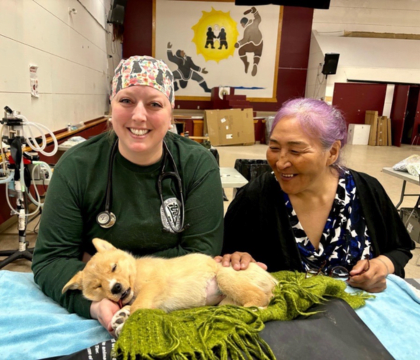 PHOTO: Helen (right), VWB Community Receptionist, with a veterinary volunteer at a northern clinic.
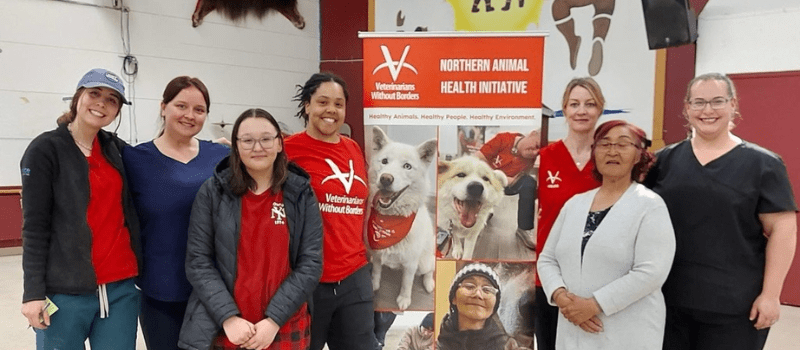
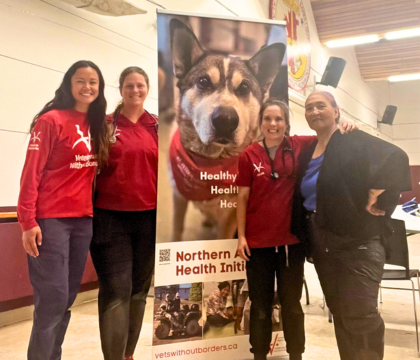 PHOTO: Helen with members of the VWB veterinary volunteer team in Kugluktuk, Nunavut.
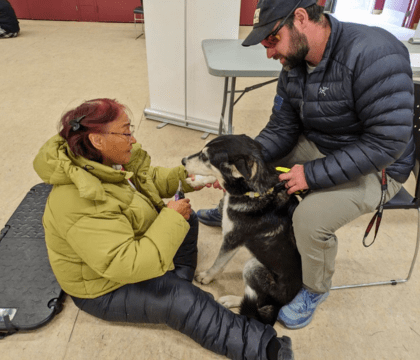 PHOTO: Helen interacting with a community member's dog during a veterinary clinic.
Bringing Veterinary Care to Kugluktuk
When Veterinarians Without Borders (VWB) arrives in Kugluktuk for one of its northern veterinary clinics, the work has already begun.
For weeks beforehand, Helen is on the phone contacting pet owners, booking appointments, sending reminders, and adjusting schedules when plans inevitably change. If someone can't make their appointment, she quickly fills the opening with another family so the veterinary team can make the best possible use of every hour they spend in the community.
On paper, her title is Community Receptionist. In practice, she is the bridge between the visiting veterinary team and the people they have come to serve. "I know I am a critical part of the team," she says. "Organizing the vets' time schedule so that they can see as many animals as possible... it's so important to have that service in our community."
Helen first connected with VWB in 2022 after returning home to Kugluktuk following a 36-year career away from the community. She had built a successful professional life, earning degrees in Political Science and Business Administration while developing strong organizational skills. But retirement also brought an opportunity to return home and contribute in a different way.
While searching online, she came across Veterinarians Without Borders. She didn't wait for an invitation. She reached out and explained that she spoke Inuinnaqtun, knew the community, and believed she could help if VWB ever came to Kugluktuk.
Soon afterward, the organization called. "They said they could use my help." For Helen, it was exactly the kind of opportunity she had been hoping to find.
When Care Is Hundreds of Kilometres Away
For many Canadians, veterinary care is a short drive away. In Kugluktuk, it is anything but.
The nearest veterinary services are roughly 760 kilometres from the community, making routine care difficult and emergency treatment expensive and complicated. Visiting clinics help close that gap by providing services such as wellness exams, vaccinations, and spay and neuter surgeries closer to home, but Helen knows firsthand what happens when animals need care between visits.
One of her own dogs was attacked by a polar bear. The injuries were severe. His ear had been nearly torn off and much of one side of his face had been badly damaged. Determined to save him, Helen arranged for him to fly south for treatment. "I spent about $4,000 on vet bills to get him back to good health," she says.
Some people questioned her decision. "I was asked why I didn't just have him taken care of by a local hunter. That was not an option for me, nor will it be if I can help it."
Experiences like this reinforce why access to veterinary care matters—not simply for emergencies, but for the everyday health and well-being of the animals that share people's lives.
Helen still has a dog today. Rusty, a collie mix she has raised since she was just six weeks old, joins her on fishing trips, snowmobile rides, and outings on the land. True to her name, Rusty has a rust-coloured coat, but it is her loyalty that Helen treasures most. "She loves to go wherever I go."
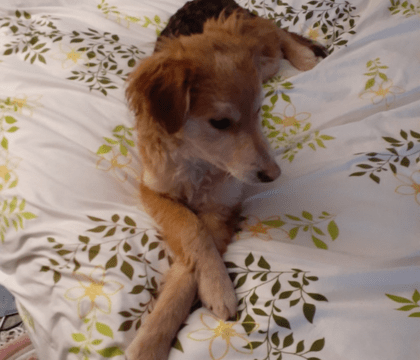 PHOTO: Rusty, Helen's nearly 10-year-old collie mix.
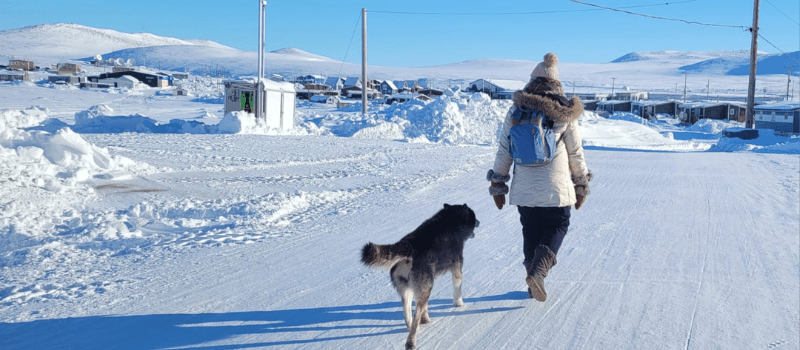
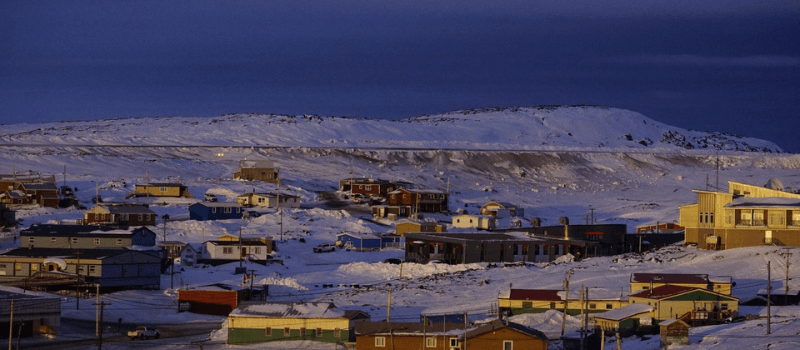 PHOTO: A snow-covered community in Nunavut surrounded by Arctic hills under the winter sky.
Building Care That Lasts
While visiting veterinary clinics remain an important part of improving access to care in northern communities, Helen believes the future goes beyond periodic visits. It lies within the community itself.
That is why she is excited by the development of Community Animal Health Workers (CAHWs)—local residents who receive training to provide basic animal health services while working alongside veterinarians. For Helen, the value of this approach extends well beyond technical skills. "It is important to have community animal health workers because they don't move away in most cases," she explains. "They know the community and its people. They can speak the language."
Those relationships matter.
People are more likely to seek care from someone they know and trust. Animals are often calmer with familiar faces. Advice is easier to understand when it comes from someone who shares the community's language and experiences. "Building trust is very important to the pet and pet owners," Helen says. "Kindness and understanding goes a long way."
She also believes local animal health workers can provide something visiting professionals never fully can: continuity. Between veterinary clinics, they can answer questions, monitor animals, support pet owners, and help identify problems before they become emergencies. That kind of community-based care strengthens animal health while building local knowledge and confidence for the future.
Knowledge That Grows Together
Helen's own life reflects the approach VWB hopes to strengthen across the North. She brings together traditional knowledge learned from her parents on the land with decades of professional experience and formal education. Rather than replacing one with the other, she sees them as complementary.
The same principle guides VWB's Northern Animal Health Initiative. Improving access to veterinary care is not simply about bringing services north. It is about working alongside communities, listening to local priorities, and supporting people who already understand the land, the language, and the relationships that make lasting care possible.
Helen hopes that, over time, even more opportunities for veterinary and animal health training will become available within Nunavut itself, making it easier for local residents to build careers caring for the animals in their own communities.
As Nunavut Day celebrates the people, cultures, and communities that make the territory unique, she often thinks back to her father and the lessons he passed on. He used to tell her, "You cannot do nothing—you have to work or go to school." Helen did both.
Today, she continues to put those lessons into practice—not only by helping visiting veterinary teams care for animals, but by helping create the conditions for communities to care for their own.
Because lasting access to animal health care doesn't begin when a veterinary team arrives. It begins with people like Helen, whose knowledge, commitment, and leadership are already rooted in the community.
 When communities lead, animal health care becomes stronger and more sustainable. Across Northern Canada, VWB works alongside community members to strengthen local capacity, improve access to veterinary care, and support community-led solutions rooted in local knowledge. Volunteer or subscribe to support community-led animal health initiatives and stay connected to our work.
Help bring veterinary care within reach. Your gift can help animals in Northern communities access the veterinary care they need while supporting community-led solutions that help care continue between veterinary visits. Give Now.