Volunteer Shauna Richards shares her insight on the importance of the work Veterinarians Without Borders is doing, especially in light of the COVID-19 pandemic.
I have been volunteering and working in collaboration with VWB/VSF in a variety of forms since 2013, inclusive of seven trips to Kenya, and one year providing distance supervision. This has mainly been as a supervisor and project coordinator for the Kenya Young Volunteer Program, and once as an independent volunteer.
I volunteer with VWB/VSF because as a veterinarian and epidemiologist I have been fortunate to gain extensive skills in animal health, disease investigation, and more broadly disease prevention measures in the context of One Health.
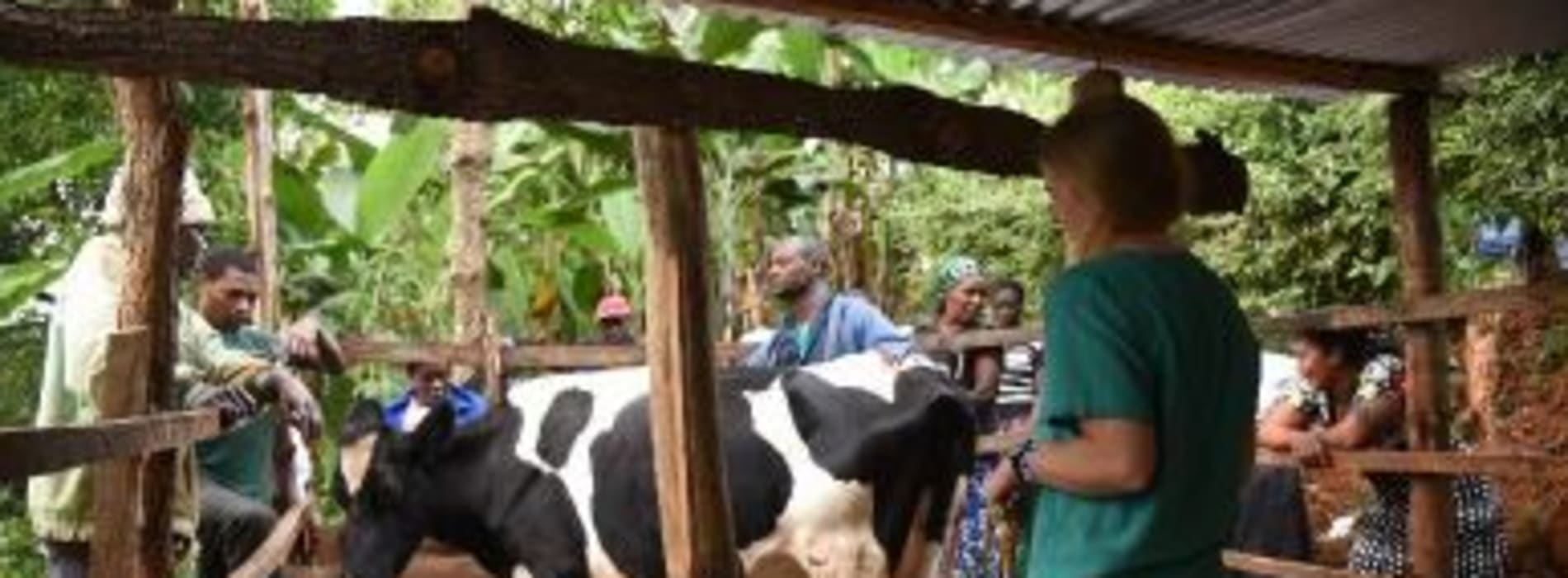
I have seen first-hand the benefits of capacity building and gender empowerment for smallholder livestock farmers, and stakeholders in the livestock sector in Kenya. The benefits are sustainable livelihoods that support families to move out of poverty, have food security, educate their children, pay for healthcare, and for women farmers to gain independence to support themselves and their children
As a vet, I also see the benefits of improved animal health and welfare, which are closely linked to the health of the people who care for them. For example, last year in Kenya for the first time we ran zoonotic disease prevention and awareness sessions with smallholder dairy farmers. These sessions emphasized priority zoonotic diseases identified by the Health Ministry in Kenya, and how to prevent both animals and people from developing these serious and sometimes fatal diseases. Since 2016, we have given zoonotic disease prevention and safety around animal sessions at primary schools in Kenya, as children are often the victims of rabies, work closely with livestock, and are at high risk for zoonoses.
As you are likely aware, COVID-19 is believed to be of animal origin. Veterinary epidemiologists are uniquely trained to identify risks and preventative measures associated with infectious diseases, especially those of zoonotic origin. Thus, VWB/VSF and their volunteers are uniquely suited to assisting smallholder livestock farmers mitigate the risk of zoonotic disease spillover from wildlife into domestic animals and humans.
Livestock owners in developing countries are often working and living at the interface of wildlife protected areas, these are high-risk locations for zoonotic disease spillover. Without appropriate knowledge, and sustainable livelihoods that protect wildlife and wild areas, new pandemic diseases will remain as a threat to global health. Unfortunately, we are now seeing that people in developing countries shoulder a higher burden in times of a global pandemic.
Right now is a critical time to assist smallholder livestock farmers in developing countries. In places like Kenya and Tanzania, a main employer outside of agriculture is tourism. With many losing their livelihoods, and limited funding for protection of national parks, poaching and destruction of wildlife protected areas is already occurring. Farmers graze animals inside of national parks not recognizing the increased risk of zoonotic disease spillover, or simply because they are unaware of other options to feed their livestock in a more sustainable manner. Poaching and destruction of wildlife protected areas leads to wildlife moving into closer contact with humans and domestic animals, further increasing the risk of zoonotic disease spillover.
To mitigate these risks, farmers need to be made aware of the risks of zoonotic diseases and be supported in their livestock-based livelihoods in a time where there is little other employment available. This is especially true for women who are often underemployed or have insecure employment outside of farming. VWB/VSF is uniquely positioned to offer this support as they are closely tied to farmer and livestock sector partners in developing countries. By supporting farmers to maintain their sustainable livestock-based livelihoods, and providing capacity development surrounding zoonotic disease prevention, the negative impact of COVID-19 can hopefully be minimized, and future pandemic risks reduced.
Sincerely,
Shauna Richards DVM PhD MRCVS
Postdoctoral Researcher – Veterinary Epidemiology
Institute of Biodiversity, Animal Health & Comparative Medicine
College of Medical, Veterinary & Life